 Homerun
Search 'house kits for sale' and you'll get thousands of results. Most lead to landing pages with stock photography and a contact form. Few publish actual prices, material specs, or what's included in the kit. This guide gives you the questions to ask and the red flags to watch for, so you can evaluate any kit supplier — including us — based on facts rather than marketing.
The 7 questions every kit supplier should answer in writing
- What's the exact list of materials included in the kit?
- Is the kit engineered for my building code jurisdiction?
- What's the lumber grade — #2 SPF, #1 SYP, engineered I-joists, or LVL beams?
- What's the wall construction — 2x4 16" OC, 2x6 24" OC, advanced framing?
- What's included for the roof — trusses or rafters, sheathing, underlayment, fasteners?
- What's the all-in delivered price to my zip code, including freight?
- What's the structural warranty — duration, what's covered, what voids it?
If a supplier won't answer all seven in writing, walk away. The serious players publish this information; the marketers hide it.
What separates a real kit from a lumber package
There's a meaningful difference between a 'kit' and a 'lumber package.' A real kit comes pre-engineered, with members cut to length, fasteners and structural hardware sized and packaged, and engineered plans documents you can hand to your building department. A lumber package is just lumber — you (or your framer) figure out the rest.
Real kits cost more upfront, but they save weeks of on-site labor and dramatically reduce material waste. They also reduce the risk of permit delays since the structural design is already documented.
Material specs that affect your home's lifespan
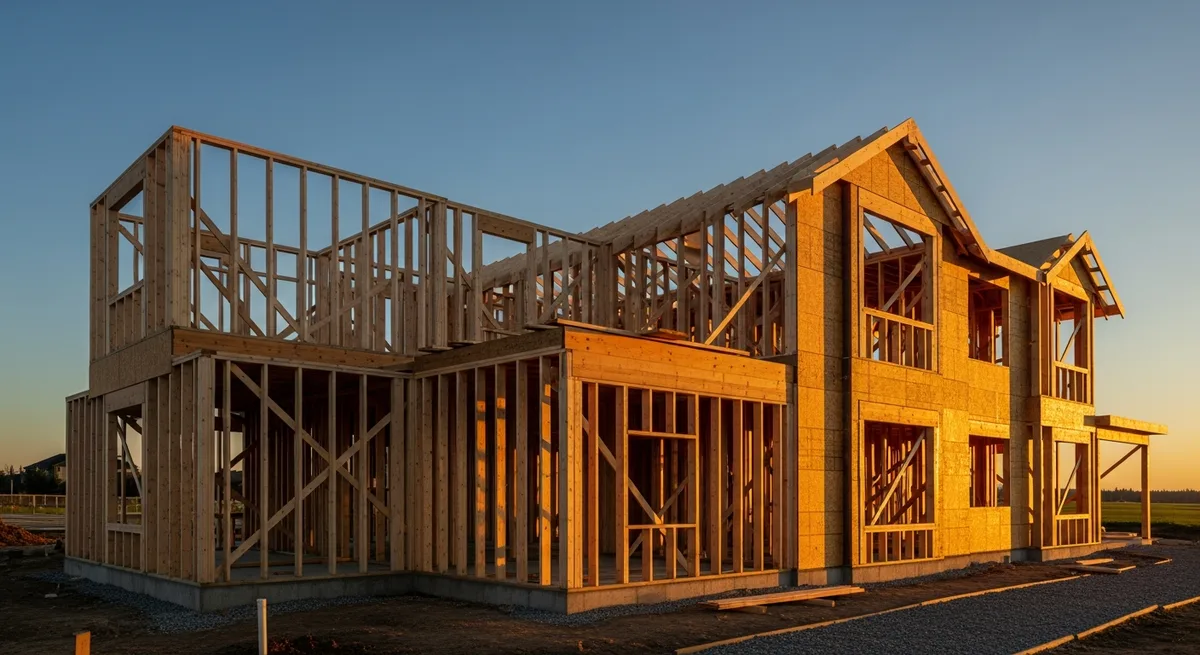
Wall framing: 2x6 at 16" on center is the modern standard for energy efficiency. 2x4 framing is acceptable in mild climates but limits insulation R-value. 24" on center spacing is fine with engineered headers but check local code.
Sheathing: 7/16" OSB is the budget standard. 1/2" OSB or plywood is more durable. Zip System or equivalent gives you weather protection during framing. Check what's actually shipped.
Roof structure: Pre-engineered trusses are standard for most floor plans and ship efficiently. Stick-frame rafter packages allow vaulted ceilings and unusual rooflines but require more on-site labor. Metal roofing panels (often included in our kits) outlast asphalt shingles 2–3x.
Delivery scope — read the fine print
'Free delivery' usually has a radius. Beyond that radius, freight is added at cost. Some suppliers ship LTL (less-than-truckload) which means transfer points and possible delays. Others use dedicated freight with crane offload. Ask: is delivery to the curb, or to a staging location on your lot? Is offload included or extra? What's the lead time after order, and is the delivery date guaranteed?
What's included vs. what's extra (the bait-and-switch)
Common items advertised as 'included' that aren't: foundation anchors, exterior doors, windows, soffit and fascia, metal roof flashing, drip edge, rake trim, building wrap. Get the line-item list. If a supplier quotes you $30K and the comparable competitor quotes $38K but includes $10K of items the cheaper supplier will charge for separately, you've been baited.
Warranty terms
Look for a structural warranty of 25–50 years on the framing system. Most reputable kit suppliers offer this. Read what voids it — common exclusions include modifications by unlicensed installers, inadequate foundation, water damage from missing flashing, or installation without following the engineering plans. Roofing warranties (when included) vary 20–50 years; metal panels typically come with paint warranties separate from substrate.
How Homerun stacks up
We publish 47 floor plans with real prices, ship with engineered plans, include 2x6 framing on most plans, and back the structural package with a 40-year warranty plus a 1-year labor warranty. Browse our House Kits catalog and run the same checklist on us — and on every other supplier you're comparing.