 Homerun
Every owner-builder asks this question early: am I really going to save money buying a kit, or is the contractor's all-in price actually competitive once you add up everything a kit doesn't include? The honest answer is that kits save money in most situations, but not in every situation. Here's how to figure out which one is right for your build.
What's actually in a house kit
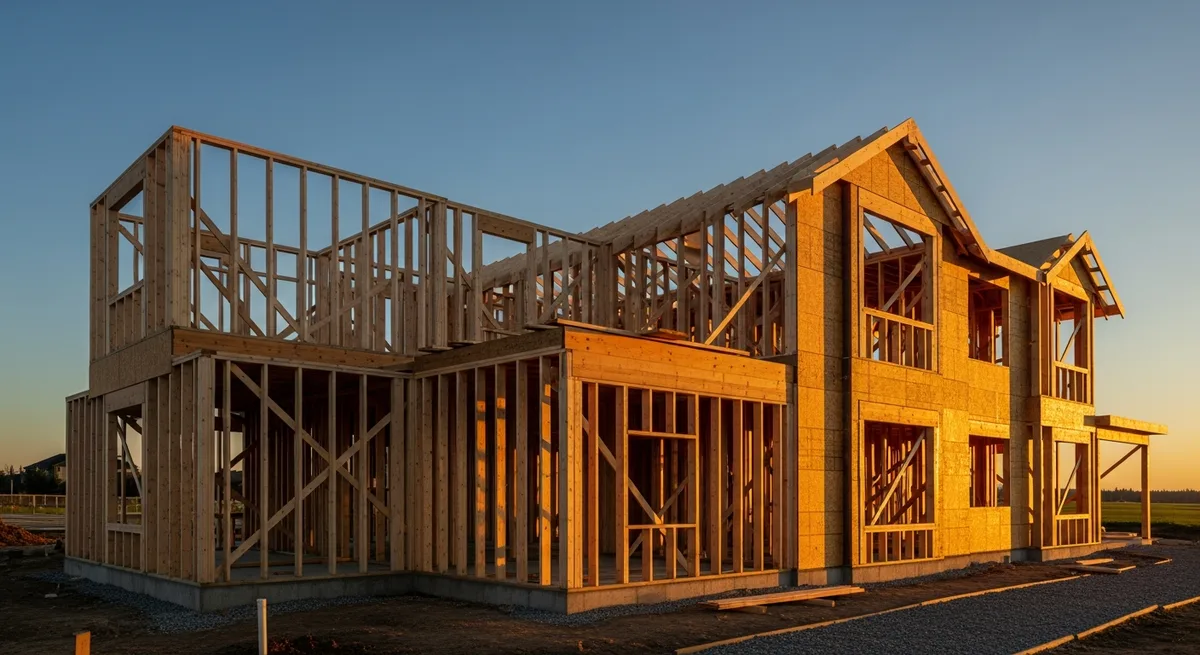
A modern house kit ships as a pre-engineered framing and shell package. The exact contents vary by supplier, but a typical Homerun house kit includes: dimensioned wall studs and plates, pre-cut floor joists or engineered I-joists, roof trusses or rafter packages, all sheathing for walls and roof, fasteners and structural hardware, exterior wall and roof underlayment, and engineered plans documents for permitting.
What's NOT in a typical kit: foundation, mechanicals (HVAC/plumbing/electric), insulation, drywall, doors, windows, siding (sometimes included, sometimes not), kitchen and bath cabinets, flooring, paint, and final permits/inspections. These are sourced and installed separately.
What 'stick-built' actually means
Stick-built means a contractor frames the home from raw lumber on site — measuring, cutting, and assembling every component. The contractor typically sources lumber from a local yard, hires their own framing crew, and includes the framing labor in the project price. From a buyer's perspective, stick-built often means a single all-in contract with one builder.
The real cost comparison — 1,500 sq ft, 3-bed/2-bath
- Kit-built (Homerun house kit + owner-builder): $42K kit + $18K foundation + $50K mechanicals + $35K finishes = ~$145K total
- Stick-built (full-service contractor): $185K–$240K all-in for the same square footage in the same market
- Stick-built (owner-builder hiring trades directly): $155K–$190K
The headline savings range from $40K to $95K depending on how much project management you take on. The kit itself isn't dramatically cheaper than equivalent lumber from a yard — the savings come from precision (less waste), labor (no on-site dimensioning), and the time compression that lets you close faster.
Where stick-built wins
Stick-built makes sense when you want a heavily customized floor plan that doesn't fit a stock kit, when you need a single-contract turnkey arrangement, or when local labor is cheap and abundant. Custom one-off designs with unusual rooflines, complex layouts, or non-standard ceiling heights are often easier to build stick than to engineer as a kit.
Where house kits win
Kits are the better choice when you want a predictable price locked in before you start, when you're acting as your own general contractor, when speed matters, or when you live in an area with limited skilled framing labor. They also win when permitting requires engineered plans — the kit ships with the documents.
Timeline difference
Framing time on site for a kit is typically 5–10 days versus 3–6 weeks for stick-built. The shorter time-to-dry-in means less weather exposure, less site theft risk, and faster progress for lender draw schedules. Lead time for kit manufacturing is 6–12 weeks, so the total calendar can be similar — but the on-site critical path is much shorter with a kit.
How to decide
Pick the path that matches your strengths. If you can read a plan and coordinate trades, a kit will save you significant money. If you'd rather hand the entire job to one builder and pay a premium for the simplicity, a turnkey stick-built contract may be worth it. We're happy to give you an honest opinion on which approach fits your project — call our team at 765-748-6067.